



How Do Magnetic Materials Affect Transformer Performance?
The magnetic material used in a transformer core has a major impact on the transformer’s efficiency, size, temperature, and operating reliability. Although the winding structure and electrical design are important, the core material determines how effectively the transformer can transfer energy through a magnetic field.
Different applications require different magnetic materials. High frequency transformers used in switching power supplies typically rely on ferrite cores, while low frequency power transformers often use silicon steel cores. Selecting the correct magnetic material is essential for achieving the desired performance.
Why Are Magnetic Materials Important in Transformers?
A transformer works through electromagnetic induction. When alternating current flows through the primary winding, it creates a changing magnetic field inside the core. This magnetic flux transfers energy to the secondary winding.
The magnetic core provides a low-reluctance path for the magnetic field, allowing energy to transfer more efficiently.
The characteristics of the core material affect:
- Energy transfer efficiency
- Core losses
- Operating frequency
- Power density
- Temperature rise
- Transformer size
- Long-term reliability
A poorly selected magnetic material can lead to excessive losses, overheating, and reduced transformer performance.
Core Loss and Transformer Efficiency
One of the most important factors affected by magnetic materials is core loss.
Core loss is the energy converted into heat inside the magnetic core during operation. It mainly consists of:
Hysteresis Loss
Hysteresis loss occurs because the magnetic material must repeatedly change its magnetization direction during each AC cycle.
Materials with lower hysteresis loss require less energy to switch magnetic states, improving transformer efficiency.
Eddy Current Loss
Eddy currents are small circulating currents generated inside the core when the magnetic field changes.
High electrical resistance magnetic materials reduce eddy current losses, especially at high frequencies.
Ferrite materials are widely used in high frequency transformers because their high electrical resistivity helps minimize these losses.
Ferrite Materials in High Frequency Transformers
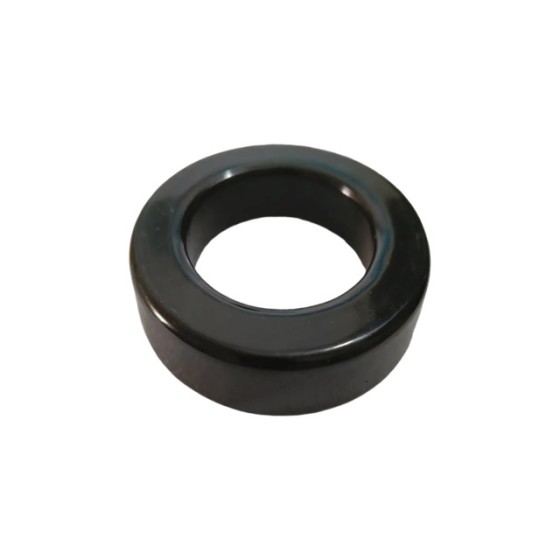
Ferrite is one of the most common magnetic materials used in modern electronic transformers.
Ferrite cores provide:
- High magnetic permeability
- Low power loss
- Excellent high frequency performance
- High electrical resistance
They are widely used in:
- SMPS transformers
- High frequency transformers
- Inductors
- EMI filter components
Common ferrite materials include:
MnZn Ferrite
Manganese zinc (MnZn) ferrite is commonly used for lower and medium frequency applications.
Advantages include:
- High permeability
- Strong magnetic flux capability
- Good power handling
Typical applications:
- Power transformers
- Power inductors
- Common mode chokes
NiZn Ferrite
Nickel zinc (NiZn) ferrite has higher electrical resistance and performs better at higher frequencies.
Typical applications:
- High frequency transformers
- RF components
- EMI suppression components
Silicon Steel for Low Frequency Transformers
Traditional power transformers operating at 50 Hz or 60 Hz usually use silicon steel cores.
Silicon steel offers:
- High magnetic flux density
- Good mechanical strength
- Low cost for large transformers
However, it is not suitable for high frequency operation because core losses increase significantly at higher frequencies.
Magnetic Permeability and Transformer Design
Magnetic permeability describes how easily a material can support magnetic flux.
A material with high permeability allows:
- More efficient magnetic coupling
- Smaller core size
- Lower magnetizing current
However, extremely high permeability is not always ideal.
Engineers must balance permeability with:
- Operating frequency
- Saturation characteristics
- Temperature performance
- Required power level
Saturation Characteristics
Magnetic saturation occurs when the core reaches its maximum ability to carry magnetic flux.
When saturation happens:
- Inductance decreases
- Current increases rapidly
- Heat generation rises
- Components may fail
A good transformer core material should provide sufficient saturation flux density for the application.
Different magnetic materials have different saturation characteristics, which affects transformer design limits.
Temperature Effects on Magnetic Materials
Temperature can significantly influence magnetic performance.
As temperature increases:
- Magnetic permeability may decrease
- Core losses may increase
- Saturation characteristics may change
Transformer designers consider:
- Maximum operating temperature
- Core material temperature characteristics
- Cooling methods
High-quality magnetic materials help maintain stable performance under different environmental conditions.
Magnetic Materials and Transformer Size
The choice of core material directly affects transformer size.
High-performance magnetic materials allow:
- Higher operating frequencies
- Smaller core dimensions
- Higher power density
This is why modern electronic devices use compact ferrite-core transformers instead of traditional large iron-core transformers.
Applications such as:
- Laptop chargers
- EV chargers
- AI server power supplies
- Renewable energy converters
all rely on advanced magnetic materials to achieve smaller and more efficient designs.
How to Choose the Right Magnetic Material?
Selecting the correct material depends on several factors:
Operating Frequency
Higher frequencies usually require materials with lower core losses.
Power Level
Higher power applications require materials with better flux handling capability.
Temperature Range
The material must maintain stable performance at the expected operating temperature.
Application Requirements
Different products have different priorities:
- Compact size
- Low cost
- High efficiency
- High reliability
A proper material selection balances all these factors.
Future Development of Transformer Magnetic Materials
As power electronics continue to advance, magnetic materials are also improving.
Current research focuses on:
- Lower-loss ferrite materials
- Higher saturation flux density
- Better thermal stability
- Materials optimized for higher frequencies
- Compact magnetic structures
The growth of electric vehicles, renewable energy systems, fast chargers, and AI data centers is driving demand for more efficient transformer cores.
Magnetic materials are one of the most important factors determining transformer performance. They influence efficiency, heat generation, operating frequency, size, and reliability.
From ferrite cores used in high frequency transformers to silicon steel cores used in traditional power transformers, each material has specific advantages for different applications.
Choosing the right magnetic material allows transformer manufacturers to achieve better energy efficiency, higher power density, and more reliable operation in modern electronic systems.