


How to Choose an Inductor for a DC-DC Converter?
Inductors are one of the most important components in a DC-DC converter. They store energy, smooth current, reduce output ripple, and help maintain stable voltage regulation. Choosing the wrong inductor can reduce efficiency, increase heat generation, or even cause the converter to become unstable.
Whether you're designing a buck converter, boost converter, or buck-boost converter, selecting the proper inductor requires evaluating several electrical and mechanical parameters rather than simply choosing an inductance value.
Why Is the Inductor Important?
A DC-DC converter rapidly switches current on and off using power semiconductor devices. During each switching cycle, the inductor stores energy when the switch is on and releases that energy when the switch is off.
This process allows the converter to:
- Regulate output voltage
- Reduce current ripple
- Improve efficiency
- Store temporary energy
- Protect switching devices from excessive current changes
The performance of the entire power supply depends heavily on the quality of the inductor.
Determine the Required Inductance
The first step is selecting the appropriate inductance value.
The required inductance depends on several factors, including:
- Input voltage
- Output voltage
- Output current
- Switching frequency
- Desired ripple current
A larger inductance generally produces lower ripple current and smoother output, while a smaller inductance allows faster transient response but increases ripple and switching losses.
Most DC-DC converter controller datasheets provide recommended inductance ranges for their reference designs.
Check the Saturation Current
Saturation current is one of the most critical specifications.
When the current exceeds the saturation rating, the magnetic core begins to saturate, causing the inductance to decrease rapidly.
This may result in:
- Reduced efficiency
- Excessive ripple current
- Higher temperatures
- Converter instability
- Possible component damage
A good design practice is to choose an inductor with a saturation current comfortably above the converter's maximum peak current.
Consider the RMS Current Rating
The RMS current rating indicates how much continuous current the inductor can safely carry without overheating.
Selecting an inductor with an insufficient RMS current rating may cause:
- Excessive temperature rise
- Reduced reliability
- Shortened component life
Always ensure the RMS current rating exceeds the maximum expected operating current.
Evaluate DC Resistance (DCR)
DC resistance affects conduction losses.
A lower DCR offers several advantages:
- Higher efficiency
- Lower heat generation
- Reduced voltage drop
- Better high-current performance
However, reducing DCR often requires a larger inductor or thicker winding wire, which may increase cost and size.
The ideal choice balances efficiency with available board space.
Match the Switching Frequency
Switching frequency directly influences inductor selection.
Higher switching frequencies generally allow:
- Smaller inductance values
- Smaller magnetic components
- Faster transient response
However, higher frequencies also increase switching losses and core losses.
The inductor should be designed specifically for the intended operating frequency.
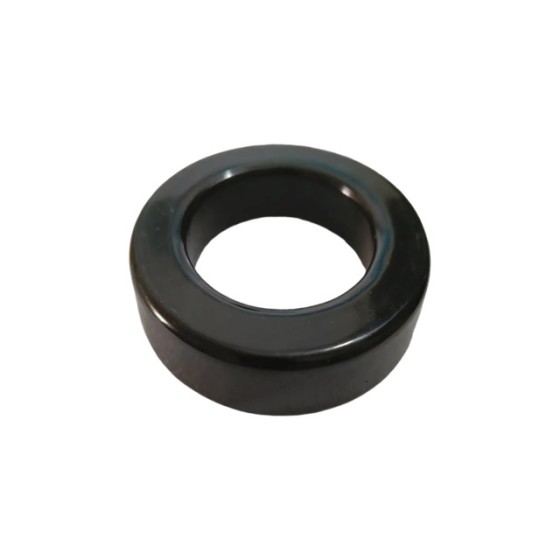
Choose the Right Core Material
Different magnetic materials provide different performance characteristics.
Ferrite Core
Ferrite cores are widely used because they offer:
- Low core loss
- Excellent high-frequency performance
- High efficiency
They are commonly used in switching regulators operating at medium to high frequencies.
Powder Core
Powder cores provide:
- Better resistance to saturation
- Distributed air gaps
- Stable inductance under high current
They are often selected for high-current applications.
The choice depends on operating frequency, power level, and efficiency requirements.
Shielded or Unshielded?
Power inductors are available in shielded and unshielded designs.
Shielded Inductors
Advantages include:
- Lower electromagnetic interference (EMI)
- Reduced magnetic leakage
- Better performance in compact circuits
They are commonly used in consumer electronics, automotive systems, and communication equipment.
Unshielded Inductors
Advantages include:
- Lower cost
- Simpler construction
- Good cooling performance
These are suitable when EMI is not a major concern.
Consider Size and Thermal Performance
Modern electronic devices continue to become smaller, but reducing the inductor size can affect performance.
A compact inductor may have:
- Higher temperature rise
- Increased DC resistance
- Lower current capability
Engineers should evaluate:
- Available PCB space
- Cooling conditions
- Ambient temperature
- Required reliability
Good thermal performance helps extend product lifespan and maintain stable operation.
Common Applications
Power inductors for DC-DC converters are widely used in:
- Laptop power supplies
- Smartphones
- Industrial control systems
- Electric vehicles
- Renewable energy systems
- LED drivers
- Telecommunications equipment
- AI server power supplies
Each application has different requirements for efficiency, size, and current handling.
Common Selection Mistakes
Some common design errors include:
- Choosing an inductance value based only on size
- Ignoring saturation current
- Selecting an inductor with excessive DCR
- Overlooking thermal performance
- Using an unshielded inductor in noise-sensitive circuits
Carefully reviewing the converter specifications and operating conditions helps avoid these issues.
Selecting the right inductor for a DC-DC converter involves much more than choosing a component with the correct inductance value. Engineers must also consider saturation current, RMS current, DC resistance, core material, switching frequency, EMI performance, and thermal characteristics.
A properly selected inductor improves efficiency, reduces heat, enhances reliability, and ensures stable converter operation. As power electronics continue to demand higher power density and better energy efficiency, inductor selection remains one of the most important aspects of successful DC-DC converter design.