






IBM releases the worlds first 0.7nm chip technology, with three-dimensional nano-stacking architecture integrating hundreds of billions of transistors.
IBM officially announced the launch of the worlds first sub-1 nanometer chip technology, with a process node of 0.7 nanometers (i.e., 7 angstroms), adopting a revolutionary three-dimensional "Nanostack" transistor architecture. This is the industrys first known nanosheet-based three-dimensional design, marking the semiconductor industrys official transition from the nanometer era to the atomic scale era.
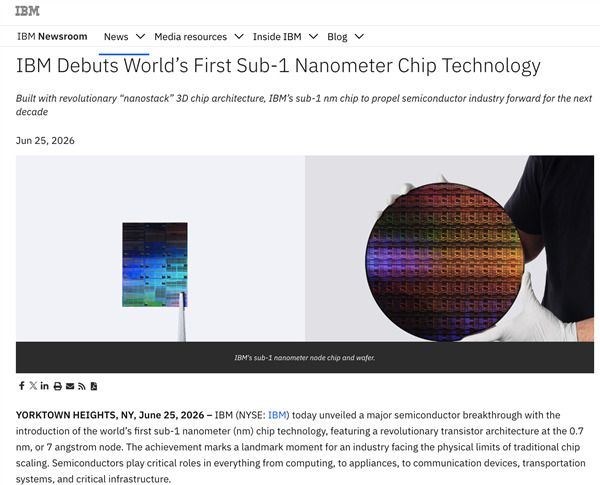
Following the announcement, IBMs U.S. stock rose over 6% in pre-market trading.

Transistor Density Doubles, Approaching Physical Limits
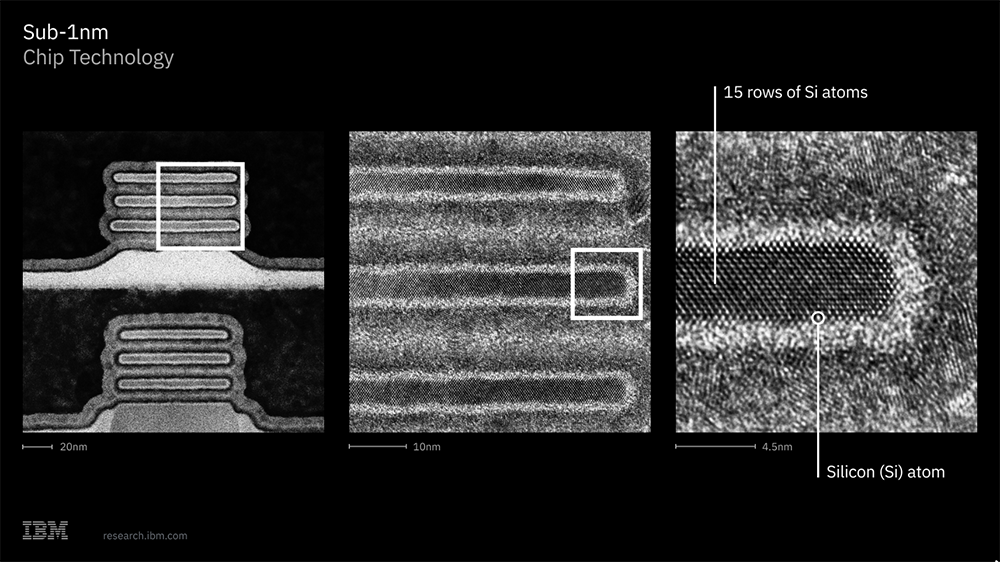
The 0.7nm chip released by IBM integrates nearly 100 billion transistors in an area the size of a fingernail, with a transistor density approximately twice that of IBMs 2nm chip released in 2021. To put this size into perspective, the width of a human red blood cell is about 7,000 nanometers, roughly 10,000 times larger than this new node size. Microscopic images released by IBM show that the chips channel region is only about 15 silicon atoms wide, with individual silicon atoms clearly visible.
According to the published technical results, compared to IBMs 2nm node chip, the new chip can achieve up to a 50% performance improvement or up to a 70% energy efficiency improvement. In terms of AI computing power, current mainstream AI accelerators offer around 1,500 TOPS (trillion operations per second), while chips using 7-angstrom technology are expected to reach approximately 7,000 TOPS, about seven times higher. If used to train todays large-scale cutting-edge large language models, the training cycle could be significantly compressed from about three months to just a few weeks.
Jay Gambetta, Director of IBM Research and IBM Fellow, stated: "IBMs latest chip breakthrough is a milestone moment in computing, pushing technology from the nanometer era to the atomic scale. With the new nanostack architecture, we are not just making smaller transistors but reinventing the way chips are built to achieve greater performance and higher energy efficiency."