




NXPs EIS technology implementation begins a new journey in battery management technology.
Recently, with NXP Semiconductors successfully developing and launching the industrys first hardware-level synchronous mechanism-based Electrochemical Impedance Spectroscopy (EIS) Battery Management System (BMS) chipset, the new energy vehicle and energy storage industries are expected to usher in a landmark technological innovation in 2025.
Leapfrog Upgrade from Traditional Monitoring to Precision Diagnosis
For a long time, traditional BMS has primarily relied on external sensors such as temperature and voltage to monitor battery status. This monitoring method has a delay of several minutes in perceiving dynamic changes inside the battery cells, making it difficult to provide early warnings for thermal runaway risks. NXPs EIS technology monitors the entire battery pack by sending controlled electrical excitation signals, successfully transforming laboratory-level cell diagnostic capabilities into practical applications. This effectively breaks through the aforementioned technical bottlenecks and provides a new technical pathway to address key industry challenges such as battery thermal runaway, fast-charging safety, and lifespan degradation.
The key challenge in implementing EIS technology lies in ensuring precise time alignment between the excitation signal and the acquisition signal. Only by achieving this goal can the phase difference of the cell impedance be accurately calculated, thereby inferring the internal state of the cell. Zhu Yuping, Director of Electrification Marketing for NXP Semiconductors Greater China, explained that NXP has built a robust "iron triangle" architecture using the BMA7418 cell sensor, BMA6402 communication gateway, and BMA8420 battery junction box controller, successfully achieving the industrys first hardware-level nanosecond synchronization with a time accuracy of 150 nanoseconds. This marks a leapfrog development from "lagging monitoring" to "precision diagnosis."
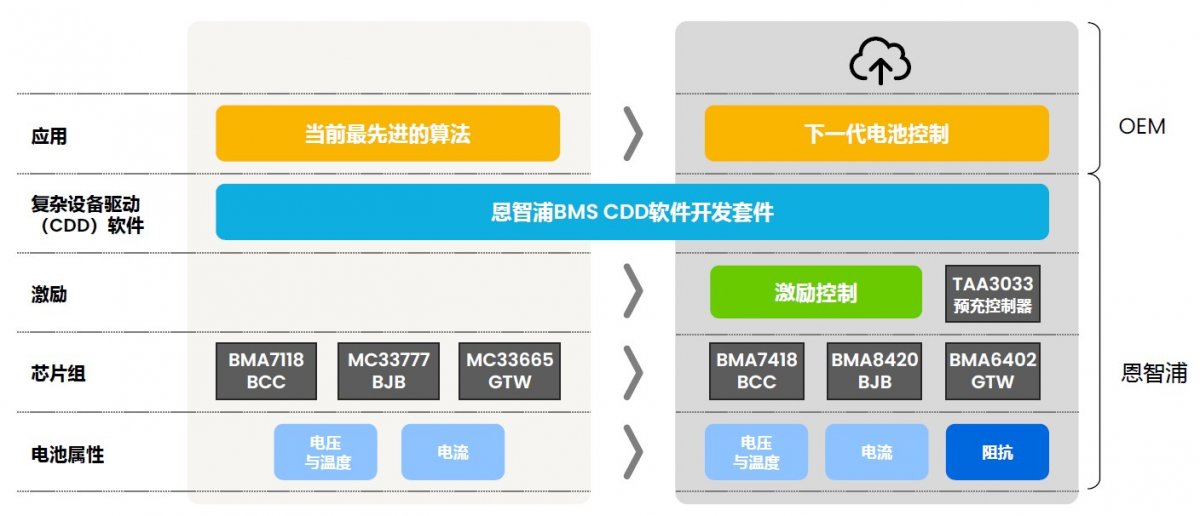
Compared to some competitors technical solutions that require additional excitation modules, NXP fully considers industry application costs and adopts a pin-compatible package design. Existing BMS systems only need to upgrade the original chip (e.g., the 7118 chip) to the BMA7418 and update the MCU software accordingly to enable the EIS function, without the need to redesign the hardware architecture. Additionally, this technology cleverly utilizes the existing pre-charge controller and DC bus capacitors within the battery pack to generate excitation signals, avoiding additional hardware investment and significantly lowering the barrier to technology adoption.
By injecting controlled electrical signals with a frequency range of 0.1Hz to 1kHz into the cells, the EIS system can obtain cell response data across different frequency bands: high-frequency bands reflect the impedance characteristics of the electrochemical solution, mid-frequency bands represent the charge transfer impedance, and low-frequency bands are correlated with the lithium-ion diffusion state.
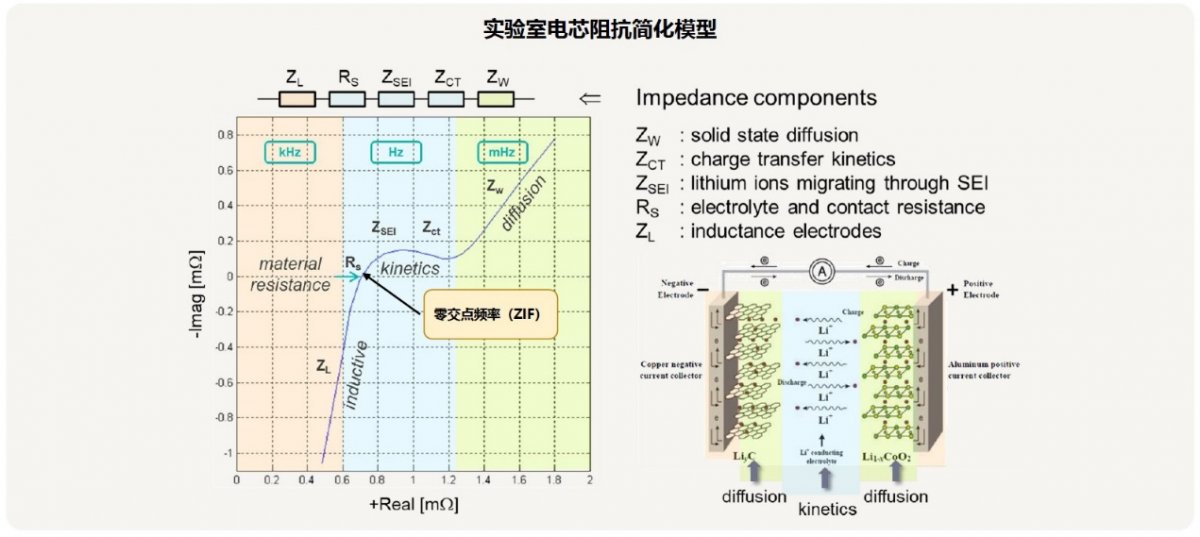
Impedance is closely related to the electrochemical behavior of the battery
This technology can monitor the internal temperature of the cells in real-time without relying on built-in temperature sensors, breaking free from the dependence on external sensors in traditional solutions. At the same time, it can identify the risk of lithium plating early, reducing the possibility of short-circuit accidents at the source, thereby adding a critical line of defense for battery safety. In terms of battery State of Health (SoH) assessment, the accuracy of EIS technology is significantly superior to traditional BMS systems. Compared to traditional estimation methods for battery health status, its evaluation results are closer to the actual degradation of the battery, effectively improving the reliability of battery management.
Differentiated Solutions for Full-Field Applications
Currently, NXPs EIS technology has entered the Proof of Concept (POC) phase with multiple automakers. According to the roadmap, this technology is expected to achieve commercial application in early 2026, and by 2030, it is projected to become an industry-standard configuration, demonstrating significant technical adaptability across different application scenarios.
In the field of new energy passenger vehicles, EIS technology effectively resolves the industry contradiction between "fast charging efficiency and safety" and "battery life and user experience." In fast-charging scenarios, the system can dynamically adjust the charging current based on the real-time state of the cells, enabling efficient energy replenishment while ensuring safety. At the same time, by accurately tracking the cell degradation process, it provides reliable data support for battery second-life applications, helping to maximize the value of the battery throughout its lifecycle. Currently, some automakers have planned to advance the trial implementation of this technology. According to industry plans, mass production and application will gradually be achieved in 2026, accelerating its penetration in the passenger car market.
In energy storage scenarios, particularly large-scale storage projects on the power generation side, the requirements for battery management differ significantly from those of passenger vehicles. Energy storage batteries need to operate continuously and stably in a static environment for 15-25 years, and any single failure could lead to large-scale power outages. NXP has optimized the EIS technical solution for this scenario, leveraging the existing equipment in the energy storage system to generate suitable excitation signals, meeting the monitoring needs of large-capacity cells. This provides technical support for the long-term safe operation of energy storage batteries. Currently, this technology has attracted industry attention and is expected to be included in the R&D planning for next-generation energy storage systems, helping to reduce failure risks and optimize operational economics.
In the commercial vehicle and robotics application domains, EIS technology also demonstrates practical value. In commercial vehicle scenarios, the system can adjust the discharge current in real-time based on operating conditions, reducing cell losses under high-load conditions. In robotics scenarios, by accurately assessing battery health, unnecessary battery replacements can be avoided, helping to control maintenance and operational costs. Currently, NXP has initiated technical collaborations with several robotics manufacturers to promote the implementation of this technology in the robotics field, accelerating its adoption in specific scenarios.
Reshaping the Competitive Landscape of Battery Management
The emergence of NXPs EIS technology is reshaping the competitive landscape of the battery management industry from three dimensions: cost optimization, safety management, and industry chain collaboration.
Traditional BMS systems typically require multiple types of sensors installed inside the battery pack to ensure safety, resulting in relatively high overall costs. EIS technology achieves multi-dimensional monitoring through advanced software algorithms, reducing the number of external sensors and effectively optimizing the cost structure. More importantly, EIS technology shifts the competitive focus of battery management from hardware configuration to software algorithms and data modeling capabilities. The supporting software for NXPs S32K358 platform allows customers to customize monitoring parameters according to their needs, significantly lowering the technical entry barrier for the industry and creating conditions for more enterprises to participate in battery management technology innovation.
At the safety management level, EIS technology achieves a critical shift from "post-event handling" to "pre-event warning" in battery safety management. In relevant test scenarios, the EIS system can issue early warnings when early-stage abnormalities appear in the cells (e.g., initial stages of lithium plating). Compared to traditional BMS systems that trigger alarms only when cell issues become more apparent, this allows ample time for emergency response, significantly enhancing the proactivity of battery safety protection.
In the past, there was a clear data barrier between cell manufacturers and vehicle manufacturers. Cell manufacturers possess the factory parameters of the cells but have difficulty accessing real-time status data during actual use. Vehicle manufacturers have battery usage data but lack the original design models of the cells, making it challenging to achieve precise battery management and affecting overall performance and safety.
The emergence of EIS technology effectively breaks down this data barrier between the two parties. Taking a collaboration case within the industry as an example, cell companies and technology providers incorporate EIS monitoring data into the cell quality feedback system. By analyzing actual operational data from different vehicle models, they can reversely optimize cell design and production processes, further improving cell cycle life. This promotes the industrys transition from single-point technology innovation to system integration innovation, accelerating the formation of a new pattern of collaborative development across the industry chain.