



What Is the Difference Between AC and DC Transformers?
The terms AC transformer and DC transformer are often used when discussing power conversion, but they describe very different concepts. A traditional transformer is designed to operate with alternating current (AC), while direct current (DC) requires additional electronic circuits to achieve voltage conversion.
Understanding the difference between AC and DC transformers is important because transformers rely on changing magnetic fields to transfer electrical energy. Since AC naturally creates a changing magnetic field, it can work directly with transformers. DC, however, produces a constant magnetic field and cannot be transformed in the same way.
How Does an AC Transformer Work?
An AC transformer operates based on the principle of electromagnetic induction.
When alternating current flows through the primary winding, it creates a continuously changing magnetic field in the transformer core. This changing magnetic flux passes through the secondary winding and induces a voltage.
The voltage relationship between the primary and secondary sides depends on the number of turns in each winding.
A transformer can be designed to:
- Step down voltage
- Step up voltage
- Provide electrical isolation
- Supply multiple output voltages
Because AC current constantly changes direction, the magnetic field inside the core also changes, allowing continuous energy transfer.
Why Can Traditional Transformers Not Work Directly With DC?
A conventional transformer cannot operate properly with a steady DC input.
When DC is applied to a transformer, the current does not create a continuously changing magnetic field. Instead, the magnetic flux quickly reaches a fixed level.
This can cause several problems:
- Core saturation
- Excessive current flow
- Overheating
- Possible winding damage
The transformer relies on magnetic changes to induce voltage in the secondary winding. Without changing magnetic flux, there is no continuous energy transfer.
What Is a DC Transformer?
Strictly speaking, a traditional electromagnetic transformer cannot directly convert DC voltage. However, the term "DC transformer" is commonly used to describe electronic circuits that convert one DC voltage level into another.
These systems are usually based on switching technology.
The basic process is:
- DC input is converted into high-frequency AC using switching devices.
- A high-frequency transformer transfers energy between circuits.
- The output is rectified and filtered back into DC.
This allows modern power electronics to achieve DC voltage conversion while still using transformer technology.
Main Differences Between AC and DC Transformers
The main differences are related to how energy conversion is achieved.
| Feature | AC Transformer | DC Transformer |
|---|---|---|
| Input power | Alternating current | Direct current |
| Working principle | Electromagnetic induction | DC-AC switching and conversion |
| Magnetic field | Continuously changing | Requires switching to change |
| Main components | Windings and magnetic core | Switches, transformer, rectifier, control circuit |
| Typical use | Power distribution and AC systems | Electronic power converters |
Applications of AC Transformers
AC transformers are widely used in electrical power systems.
Common applications include:
- Power grid voltage conversion
- Industrial equipment
- Building power systems
- Electrical distribution
- Isolation transformers
Large AC transformers help transmit electricity efficiently by increasing voltage for long-distance transmission and reducing voltage for end users.
Applications of DC Transformer Technology
Although direct DC transformation requires electronic conversion, DC power conversion is extremely common in modern electronics.
Applications include:
- Laptop adapters
- Smartphone chargers
- Electric vehicle systems
- Battery management systems
- Solar energy systems
- Data center power supplies
These systems typically use high-frequency transformers inside switching power supplies.
The Role of High-Frequency Transformers in DC Systems
Modern DC power conversion relies heavily on high-frequency transformers.
Compared with traditional AC transformers, high-frequency transformers offer:
- Smaller size
- Lower weight
- Higher efficiency
- Better power density
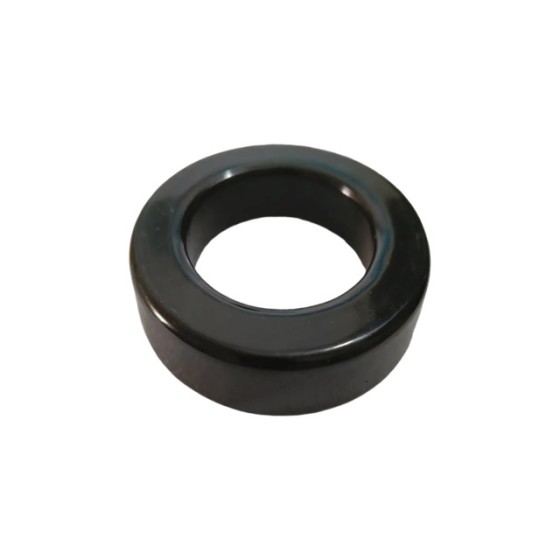
They are usually built with ferrite cores because ferrite materials perform well at high switching frequencies.
This technology allows compact devices such as chargers and power adapters to convert DC power efficiently.
Why DC Power Systems Are Becoming More Common
Many modern technologies are moving toward DC-based power systems.
Examples include:
- Battery energy storage
- Electric vehicles
- Solar power systems
- Data centers
- Consumer electronics
However, these systems still require efficient voltage conversion between different DC voltage levels. This has increased demand for advanced DC-DC converters and high-frequency transformer designs.
Choosing Between AC and DC Power Conversion
The choice depends on the application requirements.
AC transformers are suitable when:
- The power source is AC
- Simple voltage conversion is needed
- Large-scale power distribution is involved
DC conversion systems are suitable when:
- The system uses batteries or DC sources
- Precise voltage regulation is required
- Compact size and high efficiency are important
Modern electronic products often combine both technologies, using AC transformers at the input stage and DC conversion circuits for final power delivery.
The main difference between AC and DC transformers is that traditional transformers require alternating magnetic fields to transfer energy, while DC voltage conversion requires electronic switching circuits to create that changing magnetic field.
AC transformers remain essential in electrical distribution and industrial power systems, while DC transformer technology has become a key part of modern electronics, electric vehicles, renewable energy, and high-efficiency power supplies. Understanding these differences helps engineers select the right power conversion solution for each application.